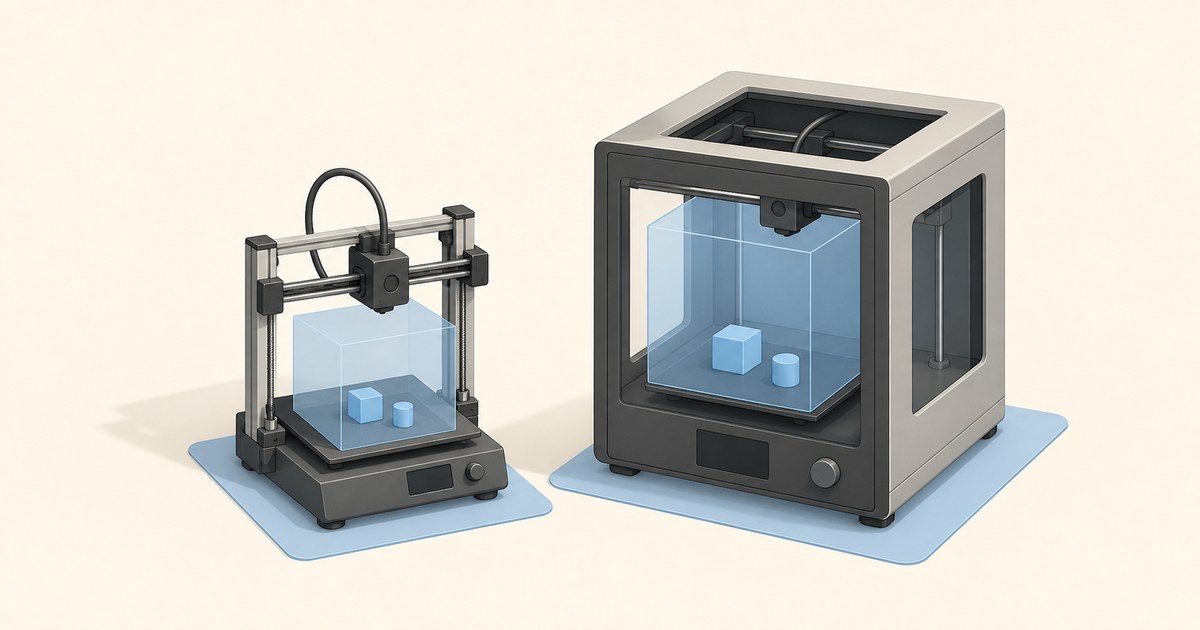
The cheapest Bambu Lab printer 2026 shoppers can buy new is the A1 mini: $209 on Bambu’s US store as of October 6, 2026, or $315.50 bundled with the four-slot AMS lite. That buys a 180 × 180 × 180 mm open-frame bed-slinger for PLA, PETG and TPU. Spend $90 more and the A1 gives you almost three times the build volume.
Those prices move. Aurora Tech Channel’s price tracker logged the A1 mini dropping from $219 to $209 on October 6, and its tracked range for the mini runs from $199 to $359. The top of that range is recent history: a Bambu forum price table recorded the mini at $359 during a 2025 tariff stage before it settled back to $249 that May. Treat every figure below as a US-store snapshot from early October 2026, not a fixed list price.
Bambu Lab printer prices by model, October 2026
| Model | Build volume | Frame | Max bed temp | Printer only | With AMS |
|---|---|---|---|---|---|
| A1 mini | 180 × 180 × 180 mm | Open | 80°C | $209 | $315.50 (AMS lite) |
| A1 | 256 × 256 × 256 mm | Open | 100°C | $299 | $399 (AMS lite) |
| P1S | 256 × 256 × 256 mm | Enclosed | 100°C | $369 | $499 (AMS), $579 (AMS 2 Pro) |
| A2L | 330 × 320 × 325 mm | Open | 80°C | $469 | $569 (AMS lite) |
| P2S | 256 × 256 × 256 mm | Enclosed | 110°C | $549 | $749 (AMS bundle) |
Prices for the A1 mini, A1, P1S and P2S come from BambuHub’s A1, P1S and P2S pages, checked October 6 and 7, 2026; the P2S bundle price is from the Aurora tracker. The A2L figures are launch prices from Bambu’s June 2026 press release. The X2D and H2 series sit above this table.
All five run a 300°C hotend, so moving up the list buys bed temperature, an enclosure and build volume, not nozzle temperature.
Is the A1 mini the best value, or just the lowest price?
It is the lowest sticker price, not the lowest cost per unit of build volume. Divide price by volume and the A1 mini costs about $36 per liter (5.83 L for $209). The A1 drops to about $18 per liter (16.78 L for $299), the P1S lands near $22, the P2S near $33, and the A2L is cheapest at about $14 per liter (34.32 L for $469).
Liters are a crude metric; what matters is whether your largest part fits on its longest axis. Before buying, load your three biggest STL files into Bambu Studio with the A1 mini profile selected. If two of three need splitting, the $90 saving disappears into gluing and sanding. The build volume and desk footprint reference has machine dimensions; the mini itself measures 347 × 315 × 365 mm.
The AMS lite bundle adds $106.50 on the mini and $100 on the A1 and A2L. If four-color work is anywhere on your roadmap, buy the combo up front.
What does the $209 A1 mini give up?
Material range is the biggest trade. The bed tops out at 80°C and the frame is open, so the rated materials are PLA, PETG, TPU and PVA, and 3DPrintBeginner’s review lists the lack of ABS support among its cons. For PLA brackets and figurines that costs you nothing. For an Etsy seller making outdoor ASA signage, it rules the mini out.
That same review recorded several numbers worth knowing before you plan a print queue:
- Heat-up time. The bed took 2 min 55 s to reach 60°C and 6 min 5 s to reach 80°C. The hotend hit 300°C in 1 min 49 s. If you run PETG near the top of the bed’s range, add six minutes of warm-up per plate.
- Plate surface temperature. A thermal camera read the textured PEI surface 5 to 10°C below the thermistor at a 60°C setpoint. The reviewer suggests raising the bed setpoint by about 5°C, which is worth trying before anything else when PETG first layers lift. The first-layer calibration guide covers the rest of that checklist.
- Power draw. About 5 W idle, about 120 W while heating, settling near 50 W during printing.
- Speed limits in practice. The mini shares the A1’s 500 mm/s and 10,000 mm/s² ceilings. The SpeedBoat Benchy finished in under 13 minutes, but a tall bust layer-shifted at high speed and completed at about 200 mm/s. On a tall, narrow part, cut speed before blaming belts.
- TPU. A flexi gecko printed with some stringing; the reviewer suggests about 220°C at the nozzle.
Setup ran about 15 minutes of unboxing and under 30 minutes to first print, plus roughly 15 minutes of motor-noise calibration. Service is less friendly: the power cable is integrated, the hotend uses plastic clips, and the silicone sock is fiddly. The AMS lite holds spools in open air, so PETG left on it absorbs moisture. The full A1 mini review covers the slicer workflow and camera.
When is the A1 the smarter cheap buy?
The A1 is the better buy whenever your parts exceed 180 mm or you want to batch several parts per plate. For $299 you get a 256 mm cube, 2.9 times the mini’s volume, and a 100°C bed. That extra 20°C does not make ABS practical on an open frame, so do not buy the A1 for engineering filaments.
BambuHub’s A1 page lists TPU 90A to 95A as supported at about 35 to 40 mm/s and marks 85A as incompatible, which matters if flexible parts are part of your shop. The A1 vs A1 mini comparison and the A1 review cover the rest of the trade, including the A1’s safety history.
There is also a refurbished route, covered in the FAQ below: a Bambu forum thread from September 3, 2026 puts a factory-refurbished A1 at around $250, roughly $40 above a new mini.
What is the cheapest enclosed Bambu Lab printer?
The P1S is the cheapest enclosed Bambu printer, at $369 on October 6, 2026 against a typical $399. Tom’s Hardware reported a fall sale at $349, a new low. If ABS or ASA is on your list, this is the price floor.
The P1S is not on its way out. When Bambu ended P1P production on February 10, 2026, its farewell post stated that the P1S will continue to be manufactured and sold, with no plans to phase it out in the foreseeable future.
The P2S costs $180 more and adds a 110°C bed plus support for AMS 2 Pro and AMS HT units, up to 20 slots. For weekly ABS and ASA work, price it out; for occasional enclosed jobs, the P1S does it. See A1 vs P1S for the open-versus-enclosed decision and P1P vs P1S if a used P1P is tempting you.
Where does the A2L fit?
The A2L is the cheapest way into a large bed, at $469 or $569 with AMS lite, launched June 1, 2026. Its 330 × 320 × 325 mm volume beats every 256 mm machine in the table. It takes up to four AMS units plus one AMS lite for 19 colors, and optional blade-cutting and pen-plotting modules.
It does not widen the material envelope. The A2L shares the mini’s 80°C bed limit and open frame, and The Crafty Catsman’s A2L review points ABS, ASA, PC and PA work toward the P2S instead. TCT Magazine reports that Bambu calls it “essentially an H2S Lite.” Buy it for cosplay pieces and large PLA or PETG parts you would otherwise split.
How do you pay less than the sticker price?
Wait for a sale, take the AMS lite as part of a combo if you will ever want it, and check refurbished stock. The mini’s tracked low is $199 and the P1S hit $349 this fall; recent drops ranged from $10 on the mini to $50 on the P1S. Then budget consumables: carbon-fiber or glass-fiber filaments need a hardened nozzle (see Bambu nozzle sizes and materials), and a spare plate is cheap insurance (see the build plate guide).
Who should buy which?
Match the printer to your largest part and your hardest material, not to the price gap.
- A1 mini ($209): small PLA, PETG or TPU parts and a tight desk. Skip it if any regular part exceeds 180 mm.
- A1 ($299): the default cheap buy for batching parts or anything longer than 180 mm. Pair it with spools from our A1 filament guide.
- P1S ($369): the cheapest path to ABS and ASA.
- A2L ($469): large single-piece PLA and PETG prints.
If you are choosing a first machine rather than the cheapest one, start with the beginner’s comparison.
FAQ
is the bambu a1 mini worth it in 2026
Yes, if your parts fit within 180 mm and you print PLA, PETG or TPU. At $209 it is the lowest-cost entry to Bambu’s ecosystem, with automatic calibration and AMS lite support. If you regularly print parts larger than 180 mm, the $299 A1 is the better value per liter of build volume.
does bambu lab sell refurbished printers
Yes. Bambu’s US store began listing refurbished A1, P1S and X1C units in September 2026, described as fully rebuilt to factory standards with a 2-year warranty and 30-day returns. Forum users report the offer is US-only and that a refurbished A1 sold for around $250. The A1 mini was not in that listing.
can the bambu a1 mini print abs or asa
Not reliably. The A1 mini’s bed tops out at 80°C and the frame is open, so ABS and ASA parts cool unevenly, warp at the corners and split between layers. Its rated materials are PLA, PETG, TPU and PVA. For ABS or ASA, the P1S at about $369 is Bambu’s cheapest enclosed option.
is the bambu lab p1p still for sale
No. Bambu ended P1P manufacturing and active sales on February 10, 2026. It still provides spare parts and technical support until February 10, 2031, firmware bug fixes and feature updates through November 14, 2027, and security patches through November 14, 2029. Bambu says the enclosed P1S stays in production.
Related across the network
- Best Budget FDM Printers Under $300 in 2026 — fdmdesk.com
- Best FDM 3D Printers 2026: Picks by Budget — fdmdesk.com