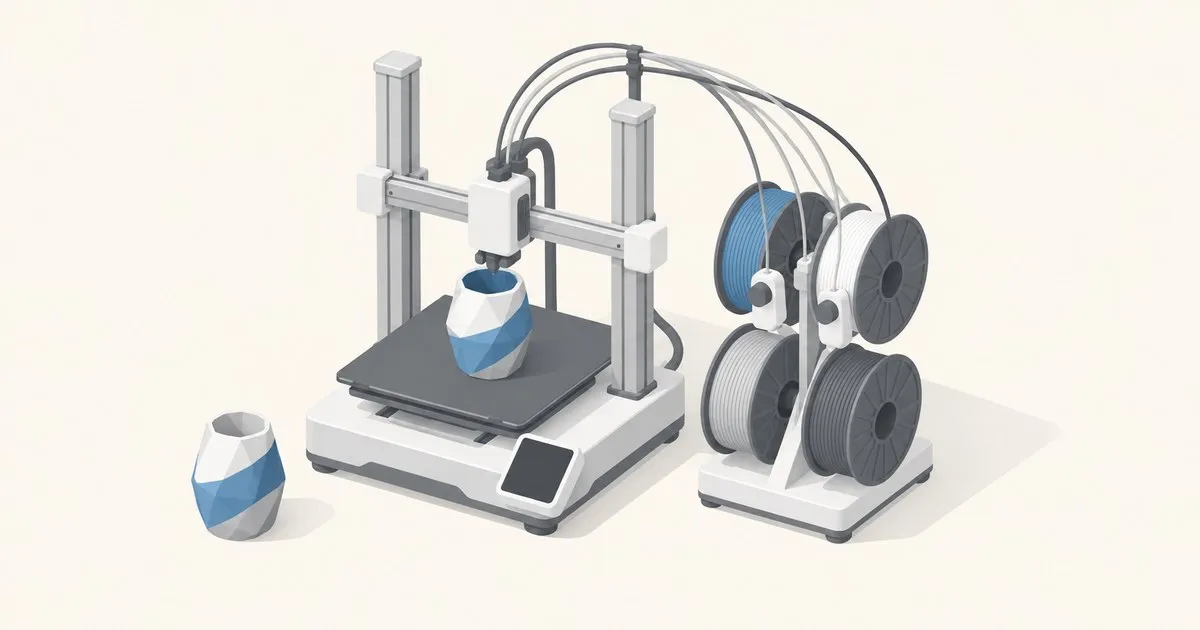
Bambu Lab A1 Review 2026: Specs, Quality, Safety
The Bambu Lab A1 runs 500 mm/s and auto-calibrates every print. What the specs mean in practice, plus the two safety issues used-unit buyers must check.
The bambu lab a1 review 2026 picture is shaped by two things that didn’t exist when the printer launched: a CPSC heatbed cable recall in 2024 and a power distribution board thermistor failure that surfaced publicly in late 2025. Units shipping now carry the redesigned board and post-date the recall. If you’re buying new, both issues are behind you. If you’re buying used, they aren’t — and that distinction matters.
Specifications
| Spec | Value |
|---|---|
| Build volume | 256 × 256 × 256 mm³ |
| Max print speed | 500 mm/s |
| Max acceleration | 10,000 mm/s² |
| Layer height range | 0.08–0.28 mm |
| Max hotend temp | 300°C |
| Max bed temp | 100°C |
| Max flow rate | 28 mm³/s |
| Extruder type | Direct drive |
| Bed surface | Flexible PEI magnetic |
| Noise level | Under 48 dB |
| AMS Lite support | Up to 4 colors (1 AMS Lite max) |
| Camera | Integrated, 1 fps |
| Connectivity | Wi-Fi |
| Enclosure | No |
| Compatible materials | PLA, PETG, TPU, ABS, ASA, PVA, HIPS |
The A1 is an open-frame bed-slinger. No enclosure. That puts ABS and ASA outside its practical operating range — warping and layer separation on those materials require a chamber above ~40°C that the A1 cannot maintain. For PLA, PETG, and TPU, the open frame is not a limitation.
Out of the Box
Assembly takes roughly 30 minutes. The A1 ships mostly pre-assembled; you’re attaching a few brackets and running a calibration sequence, not building from a kit. First-print success rate is high by any comparison: the printer runs a full auto-calibration loop — 49-point bed leveling, Z-offset, vibration compensation via input shaping, and pressure advance — before each job starts. There’s nothing to manually tune to get a usable first layer.
The included hotend is quick-swap. You can pull and replace it without tools, which makes nozzle changes practical: run a 0.4 mm hardened steel nozzle for standard work, swap to 0.6 mm for fast structural prints, swap back. The process is under two minutes once you’ve done it once.
The A1 Combo includes an AMS Lite for multi-color printing. The AMS Lite feeds up to four 1 kg spools and handles automatic filament switching for multi-color jobs. It performs reliably in normal home environments. In high-humidity conditions (above roughly 60% RH), moisture-sensitive materials like PVA will cause problems regardless of the hardware. A filament dryer alongside the AMS Lite is worth the expense if you’re in a humid climate.
Print Quality
The 500 mm/s figure is the ceiling, not the operating speed. Default quality profiles in Bambu Studio typically run 200–300 mm/s, which is still several times faster than an Ender 3-class machine. Input shaping (vibration compensation) actively suppresses ringing at higher speeds; prints at 250 mm/s show minimal ghosting on most geometries.
Layer height range of 0.08–0.28 mm covers the practical FDM range. At 0.08 mm on PLA, surface finish on flat faces is noticeably smoother than typical 0.2 mm FDM work. At 0.28 mm, layer lines are visible but structural prints come off fast. Most users end up at 0.2 mm for everyday work with 3–4 walls and gyroid or cubic infill.
The direct drive extruder makes TPU manageable. On a Bowden setup, flexible filaments require aggressive retraction tuning to avoid buckling inside the tube; direct drive eliminates that problem entirely. Retraction distances on the A1 for TPU 95A run short — 0.5–1.0 mm is typical — and pressure advance handles oozing cleanly.
PETG runs well on the PEI surface at 70–80°C bed temp and sticks without adhesive. PLA releases cleanly when the bed cools to room temperature. The flexible PEI sheet is the correct surface for both — skip glue stick for these materials. ABS is a different story: without an enclosure, first-layer adhesion is erratic and warping is likely on anything larger than 100 mm.
Flow rate calibration is worth running when switching filament brands or batches. The auto-calibration handles most cases, but a dedicated flow rate test print will confirm whether extrusion is dialed in for a specific spool.
Reliability: Two Incidents You Should Understand Before Buying Used
The A1’s hardware history includes two distinct incidents.
2024 heatbed cable recall. A manufacturing defect at the heated bed cable connector created excessive electrical resistance that caused overheating, posing fire and shock hazards. Bambu recalled approximately 12,800 affected units and issued repairs or replacements through its support channel. Any A1 purchased new today post-dates this fix; units purchased used from unknown sellers may or may not have been serviced.
2025–2026 power distribution board thermistor. A separate problem emerged publicly in late 2025. The NTC thermistor on the AC power distribution board was observed running at approximately 140°C in some units, sufficient to soften adjacent plastic. 3D Print Core documented that Bambu placed the failure rate at roughly 0.05% of units shipped and redesigned the board by removing the thermistor from late-2025 production onward. ToolGuyd reported that A1 units shipping in late December 2025 already carried the revised component.
A 0.05% failure rate is low in absolute terms, but a thermal event in a home environment is a different calculation than a percentage. Bambu offered repairs and replacements to affected owners. If you buy a used A1, ask the seller to confirm whether the board has been revised or serviced. A unit with an unverified power board from pre-late-2025 production is a reasonable concern.
Outside these two incidents, operational reliability is strong. Auto-calibration removes the most common print-failure vector — unchecked calibration drift — that plagues lower-end machines. Print failures, when they occur, are more typically filament-related (moisture, bad spool) than hardware-related.
Software and Connectivity
The A1 runs on Bambu Studio, which is built on the same codebase as OrcaSlicer. OrcaSlicer also supports the A1 directly if you want the open-source route; slicing quality is comparable between the two. Bambu Studio integrates more tightly with Bambu Cloud for remote monitoring, filament management, and OTA firmware updates.
The built-in camera operates at 1 fps. It’s the right tool for timelapse capture and post-print review; it is not useful for real-time monitoring of a fast print. Remote monitoring via the Bambu app requires cloud connectivity for full functionality.
Bambu Cloud dependency is worth stating plainly: firmware updates, remote access, and some multi-color coordination features route through Bambu’s servers. Local LAN mode is available in Bambu Studio for users who prefer not to route traffic through cloud infrastructure — this is documented in Bambu’s own setup materials. Users who follow firmware and IoT security developments (coverage at Tech Sentinel) will recognize this as a standard network-connected device tradeoff. It’s not unique to Bambu, but it’s a real dependency.
OTA updates since launch have improved input shaping and flow calibration. The update cadence is consistent.
Who Should Buy / Who Should Skip
Buy the A1 if:
- You want 30-minute setup and reliable first prints on PLA and PETG without manual calibration
- You print at 0.2 mm layer height for functional parts and want 2–4x faster throughput than an Ender-class machine
- You want multi-color printing under $500 with the A1 Combo and AMS Lite
- You’re upgrading from a manual-tune bed-slinger and want to spend time printing rather than calibrating
Skip the A1 if:
- You need an enclosure for ABS, ASA, or PC — the P1S is the correct Bambu pick for engineering filaments (see A1 vs P1S)
- You want 8-color capability — the A1 supports one AMS Lite for a 4-color maximum; the X1C with two AMS units handles 8
- You’re buying used and the seller can’t confirm the power board revision status
The A1 Combo is listed at MatterHackers and sold through the Bambu Lab US store directly. If multi-color printing is part of your plan, buy the Combo from the start — adding the AMS Lite as a separate purchase later costs more than the initial bundle price difference.
Sources
- MatterHackers — Bambu Lab A1 Combo (link): Product listing with verified build volume, speed, noise specs, and AMS Lite compatibility.
- 3D Print Core — “The Bambu Lab A1 Safety Issue: What 3D Printer Owners Need to Know” (link): January 2026 coverage of the NTC thermistor failure mode, Bambu’s stated 0.05% failure rate, and the board redesign timeline.
- ToolGuyd — “Bambu A1 3D Printer Seems to Have Another Problem” (link): 2026 documentation of the power board issue with component-level detail on the thermistor failure and symptom reports.
- 3DPut — Bambu Lab A1 Review (link): Independent review confirming layer height range (0.08–0.28 mm), direct drive extruder, PEI bed surface, and setup time.
Sources
Related
Bambu Lab A1 vs P1S: Which Printer Is Right for Your Bench?
A spec-by-spec breakdown of the Bambu Lab A1 against the P1S: acceleration, enclosure, AMS options, material support, desk footprint, and price.
Bambu A1 vs A1 Mini: Which Bed-Slinger Wins?
The A1 and A1 mini share Bambu's bed-slinger DNA but differ in build volume, desk footprint, bed temperature and price. Here is how to pick the right one.
Best Filament for Bambu Lab A1: PLA, PETG HF, TPU
Which filaments the Bambu A1 actually supports: PLA and PETG HF on the stock nozzle, TPU from a side spool, CF blends only with hardened steel.