
Best Filament for Bambu Lab A1: PLA, PETG HF, TPU
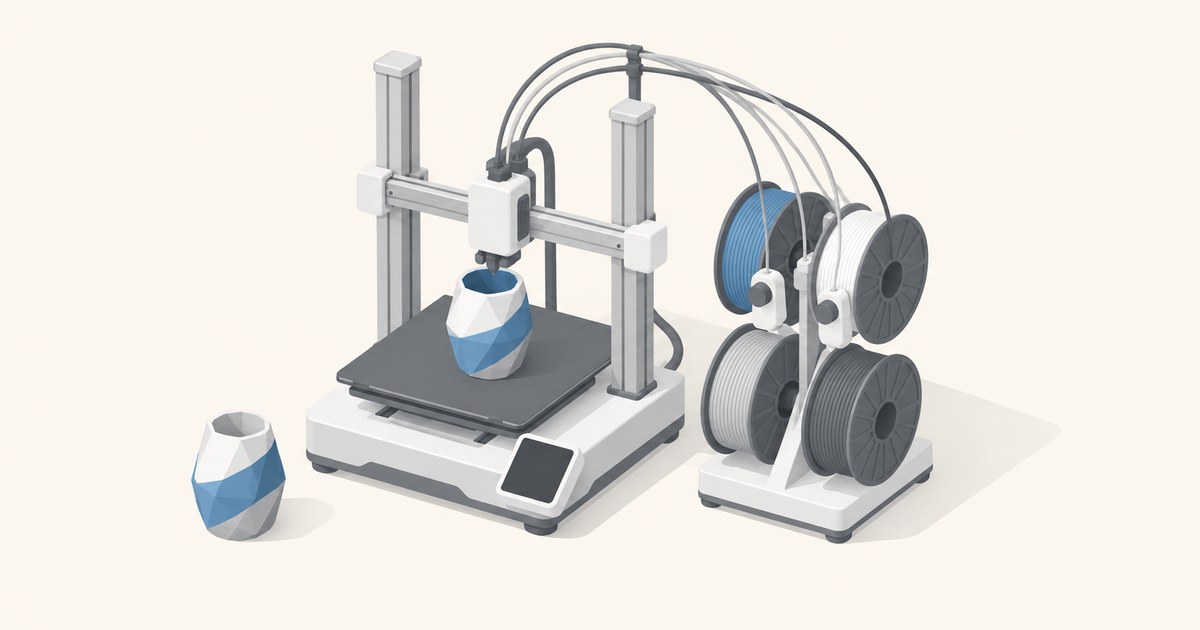
Which filaments the Bambu A1 actually supports: PLA and PETG HF on the stock nozzle, TPU from a side spool, CF blends only with hardened steel.
The best filament for Bambu Lab A1 owners is boring on purpose: PLA for 80% of what you print, PETG HF for parts that live in heat or take abuse, and TPU 95A HF fed from a side spool when you need flex. That short list isn’t a cop-out. The A1 is an open-frame bed slinger with a stock stainless steel nozzle and no chamber to trap heat, and Bambu’s own compatibility page draws the line in the same place: no ABS, no ASA, no polycarbonate, no nylon on the supported list at all. What follows is which spools to load, what nozzle each one requires, and which materials to leave for an enclosed printer.
What Bambu officially supports on the A1
Bambu publishes a per-printer filament matrix, and the A1’s version splits on nozzle material:
| Filament | Stock stainless nozzle | Hardened steel nozzle | AMS lite |
|---|---|---|---|
| PLA | Yes | Yes | Yes |
| PETG HF | Yes | Yes | Yes |
| TPU 95A HF | Yes | Yes | Not compatible |
| PVA | Yes | Yes | Yes |
| TPU 90A | No | Yes | Yes |
| PLA Glow | No | Yes | Not compatible |
| PLA-CF | No | Yes | Yes |
| PETG-CF | No | Yes | Not compatible |
Three things jump out. First, the stock stainless nozzle covers the everyday materials; the hardened steel swap exists for abrasives (carbon-fiber blends, glow pigment). Second, the matrix explicitly flags PLA Glow, PETG-CF, and TPU 95A HF as not compatible with the AMS lite, so those run from the external spool holder. Third, everything the A1 doesn’t have, an enclosure and a chamber, is exactly what the missing materials need.
PLA first: the A1 is built around it
The A1’s headline specs, 500 mm/s travel with 10,000 mm/s² acceleration, a direct-drive extruder, and a textured PEI plate, describe a machine tuned for fast PLA. The Prusa material guide puts PLA at a 185–235 °C nozzle and a 50–60 °C bed with minimal warping, which is why it’s the one material that behaves at bed-slinger speeds with no enclosure.
Mechanically, PLA is stronger than its reputation. In CNC Kitchen’s PLA/PETG/ASA comparison, printed PLA hooks held 73 kg loaded along the layers versus 55 kg for PETG, and PLA kept 55% of that strength across layer lines, the best ratio of the three materials tested.
PLA’s real limits are heat and impact. The same tests put PLA’s softening point at 60 °C with failure at 65 °C, and its impact strength at 5 kJ/m², roughly a third of PETG’s. Translation: no PLA in a parked car, on a sunny windowsill, or anywhere it takes repeated knocks. For everything else, decorative prints, prototypes, fixtures that live indoors, run the stock 0.2 mm profile with 2–3 walls and don’t overthink it. Bambu’s own spools carry RFID tags that auto-select the profile, but any reputable PLA prints fine once you pick the generic PLA preset. If you want to push speed further, SlicerGuide’s print speed guide for PLA covers where quality starts to fall off.
PETG HF when the part has a job
PETG is the step up for functional parts, and the HF (high-flow) variant is the one Bambu lists for the A1 because it keeps up with the machine’s speed profiles. Per CNC Kitchen’s numbers, PETG softens around 80 °C and fails near 85 °C, enough margin for car interiors in most climates, and its impact strength of 8.6 kJ/m² comes with a failure mode that matters more than the number: the PETG hooks in that test never snapped, they stretched. A bracket that deforms instead of shattering is a bracket you notice before it fails.
The Prusa guide lists PETG at 215–270 °C nozzle and 70–90 °C bed and recommends a glue stick, which on a smooth sheet acts as a release layer so PETG doesn’t weld itself to the plate. The A1’s textured PEI plate is more forgiving, but a thin glue film is still cheap insurance on large flat parts. Expect more stringing than PLA, and dry the spool if it’s been out of the bag for weeks; wet PETG strings no matter what retraction you set. Starting temperatures and per-material tuning are in our Bambu filament settings guide, and SlicerGuide’s material profiles walkthrough explains which slicer settings actually differ between the two.
TPU: yes, but from the side spool
Flexibles are where the A1 quietly outperforms its price class, because its extruder is direct drive: the drive gears sit on the toolhead, so soft filament has millimeters, not centimeters, of unsupported path to buckle in. Bambu supports TPU 95A HF on the stock nozzle, but not through the AMS lite; mount it on the external spool holder. The softer TPU 90A requires the hardened steel nozzle per the same matrix.
Treat TPU as a slow material on a fast printer. Prusa’s guidance for flexibles is a 220–260 °C nozzle and 40–85 °C bed, and their guide files it under advanced for a reason: retraction barely works, so accept some stringing, cut cooling back, and let the printer run at a fraction of its PLA speeds.
The hardened nozzle unlocks CF blends
PLA-CF and PETG-CF print stiffer, matte-finish parts, and chopped carbon fiber chews through stainless nozzles, which is why both appear only in the hardened-steel column of Bambu’s matrix. The A1’s quick-swap nozzle design makes the change a minutes-long job rather than a hot-end teardown; our nozzle sizes and materials guide covers when the swap is worth it. Remember that PETG-CF also skips the AMS lite, so it feeds externally.
What to skip on an A1, and why
ABS, ASA, PC, and nylon are absent from Bambu’s A1 list, and the physics backs the omission. In CNC Kitchen’s testing, ASA kept only 29% of its strength across layer lines when printed in open air (17 kg on the vertical hook versus 57 kg horizontal), improving to 20 kg inside even a mild 30 °C enclosure. An open-frame bed slinger sitting in room drafts is the worst environment those materials can be printed in. ASA’s 110 °C softening point and 18 kJ/m² impact strength are genuinely useful numbers, but if your parts need them, that’s an enclosed-printer purchase, not a settings problem; see our A1 vs P1S comparison for what that upgrade actually buys.
PVA support material is technically supported, but it absorbs moisture aggressively; keep it in a dryer and treat it as a specialty tool, not a default.
The short version
Stock A1, no extras: PLA for most prints, one spool of PETG HF for functional parts, both AMS lite-friendly. Add a hardened steel nozzle if CF blends appeal. Add TPU 95A HF on the side spool for flexibles. Skip ABS and ASA entirely, not because the hotend can’t melt them (it reaches 300 °C), but because the open frame can’t keep them warm enough to hold together.
Related across the network
- FDM Filament Types Compared: PLA, PETG, ABS, ASA, and TPU — fdmdesk.com
- PLA vs PETG vs ASA: Which Filament Should You Actually Use? — fdmdesk.com
- Best Filament for Beginners: What to Buy First — 3dfilamentguide.com
- PLA vs PETG vs ABS: Which Filament to Use — 3dfilamentguide.com
- Material Profiles: What Changes for PLA, PETG, ABS, TPU — slicerguide.com
Sources
Related

Bambu Lab Filament Guide: Settings for 6 Materials
Find nozzle and bed temperatures, wall speeds, cooling, retraction, enclosure needs, and AMS guidance for PLA, PETG, ASA, ABS, PA-CF, and TPU.

Bambu Lab Build Plate Guide: Which Plate for Each Filament
Compare Bambu Textured PEI, Smooth PEI, Engineering and Cool plates by filament, glue needs, bottom finish, cleaning and replacement signs.
Bambu Lab A1 Review 2026: Specs, Quality, Safety
The Bambu Lab A1 runs 500 mm/s and auto-calibrates every print. What the specs mean in practice, plus the two safety issues used-unit buyers must check.